A partnership led by the University of Oxford has set Oxfordshire a target of 20 privately held companies worth $1 billion or more by 2035. Its launch materials do not say how many such companies the county has today.
The Equinox 2035 Strategy, launched Oct. 19 at the House of Commons, also calls for more than £1 billion a year in venture and growth investment and 30,000 net new jobs tied to innovation. Equinox, which the university started in November 2025, brings together local government, companies, investors and other universities.
The ambition rests on a strong research base. The harder question is how to fund companies as they leave the lab, and on that measure the wider Oxford-to-Cambridge region ranks near the bottom among its international peers, according to an independent study commissioned by the government's corridor chair.
"Twenty unicorns by 2035 is absolutely achievable," said Ed Bussey, chief executive of Oxford Science Enterprises, which invests in Oxford University spinouts and backs the plan. Bussey said his firm builds one potential billion-pound company a month and has had three unicorn outcomes in the past 12 months.
What Equinox is promising
Beyond the three headline goals, Equinox wants investment from 10 top-tier U.S. venture capital funds and 10 British pension funds. It aims to bring six global companies into permanent operations in the county and to rank among the world's three most innovation-intensive clusters per head of population.
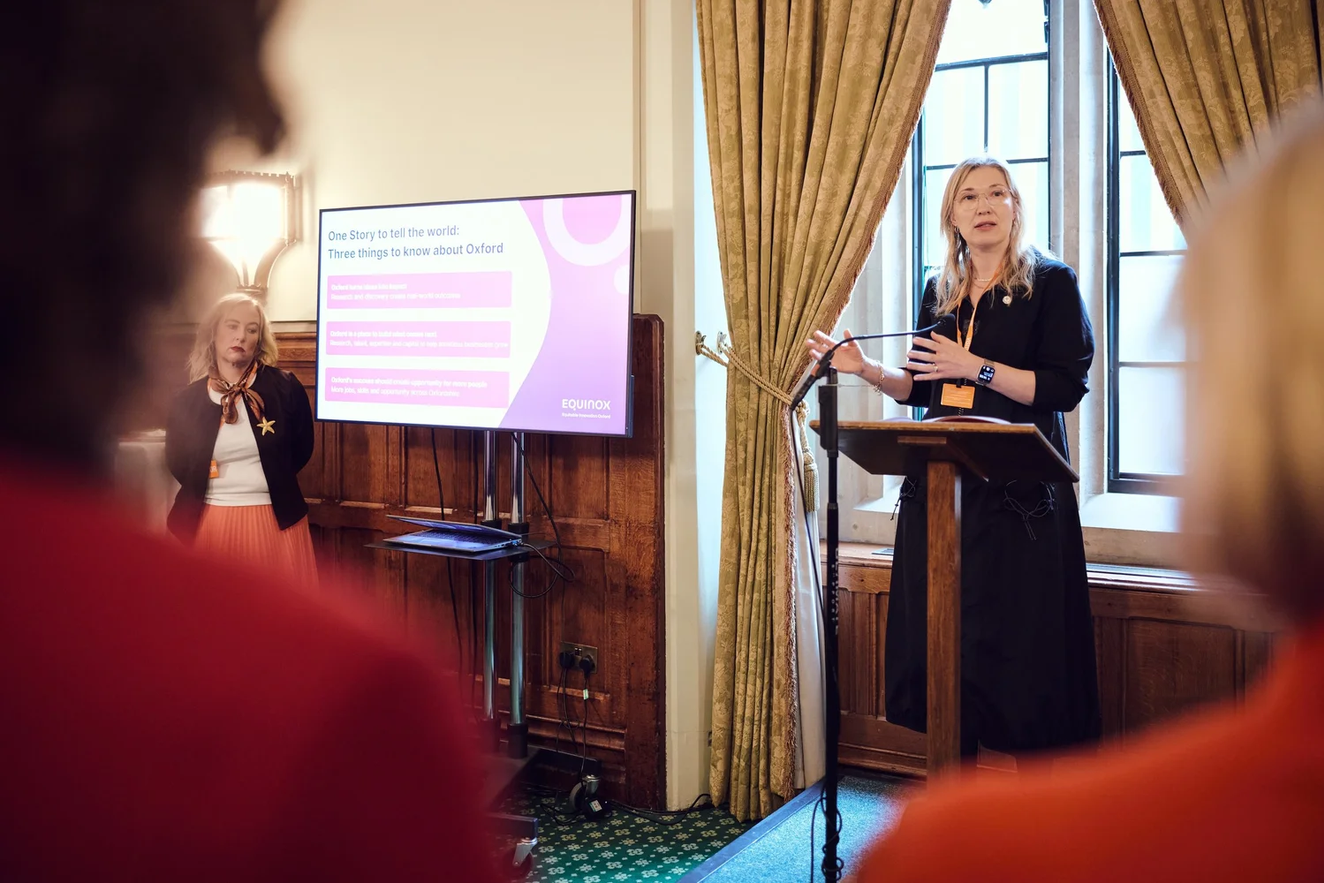
The plan's main new piece of machinery is a regional inward investment unit, meant to give investors, companies and developers a single point of contact. Equinox also plans more support for startups preparing to raise money, employer-led training routes into technology jobs and a shared regional data platform.
The published launch materials include no budget, funding source or interim milestones for any of those steps.
The starting line is unclear.
Equinox's own figures suggest how far some targets reach. The 30,000 new jobs it wants would roughly match the entire current workforce of the county's high-tech sector, by the partnership's count.
Measure | Equinox 2035 target | Latest available figure |
|---|---|---|
Unicorns | 20 | Not disclosed for Oxfordshire |
Venture and growth investment | More than £1 billion a year | Not disclosed for Oxfordshire; $1.8 billion in 2025 across the wider Oxford-Cambridge corridor |
Innovation jobs | 30,000 net new | About 30,000 people work at about 3,000 high-tech businesses |
Sources: Equinox; Public First. The corridor figure covers Oxford, Cambridge, Milton Keynes and the area between them, not Oxfordshire alone.
Spinouts are plentiful; scale-up money is not.
Equinox leans on Oxford's spinout record. Oxford spinouts raised €908 million in the first half of 2026, more than the €864 million raised across Germany's university spinout sector, the partnership said.
"Our challenge is not whether we can innovate – we have demonstrated that decisively," said Irene Tracey, vice chancellor of the University of Oxford and chair of the Equinox council.
The independent data supports her research and points to the gap in capital. Policy consultancy Public First, in a report commissioned by Lord Vallance, chair of the Oxford to Cambridge Growth Corridor, compared the corridor with 14 innovation clusters worldwide.
The corridor produced 740 university spinouts, almost double the Bay Area's 440, Public First found. But it raised $1.8 billion in venture capital in 2025, compared with more than $150 billion in the Bay Area, and ranked 14th of 15 in venture funding rounds.
About two-thirds of the unicorns founded by Oxford and Cambridge alums are headquartered outside the corridor, the report says.
For founders, that is the pattern Equinox is trying to break: companies that start in Oxford and move elsewhere to raise their later rounds. Peter Leek, chief scientific officer at Oxford Quantum Circuits, said deep-tech companies need patient capital, specialist talent, infrastructure and customers to stay.
For investors, the plan's request is specific. It names the kinds of funds it wants, top-tier U.S. venture firms and U.K. pension funds, but not the incentives it will offer them.
How it fits national targets
The Oxfordshire plan sits inside the government's goals for the wider corridor: £78 billion in additional economic output, 160,000 jobs and £105 billion in additional venture capital by 2035.
Anneliese Dodds, the Member of Parliament for Oxford East, hosted the launch and said 30,000 new jobs would be a huge opportunity for the county. More than 100 organizations have signed the Equinox charter, according to the partnership.
Whether the targets are reachable will depend on details the strategy has yet to publish. Founders and investors weighing Oxfordshire can judge progress once Equinox sets out a baseline, a budget for the investment unit and a first set of interim numbers. Until then, the county's own figures show a large research base and a small share of the growth capital it is aiming for.